

Rain Harvesting Pump Sets from $1,749
Our Most Popular Rainwater Harvesting Pumps
Choose How You Want to Order
Not every water pump setup is the same. Choose supply only if you already have a licensed installer arranged, select supply and installation together where available, or compare your options if you are still deciding what best suits your property.
Supply Only
Best if you already have a licensed plumber, pump installer or electrician arranged.
You receive the water pump and the components listed with that product. Installation and site-specific plumbing or electrical work are not included unless shown or selected separately.
Additional valves, fittings, pipework changes, electrical work, pressure controls, tanks, trenching, old pump removal, disposal or compliance upgrades may be required depending on your installation.
Supplied & Installed
Best if you want the water pump and installation organised together.
Select your preferred pump, complete the installation questions on the product page and choose any applicable installation options before checkout.
Installation availability and final requirements depend on your location, access, pump type, water source, existing pipework, electrical setup and site conditions.
Not Sure What You Need?
The right water pump depends on the pressure, flow and water source required for your property.
Compare pressure pumps, rainwater pumps, mains boosting pumps, transfer pumps, submersible pumps and pump controllers using the ranges and selection tools throughout the site.
Consider your water source, required flow and pressure, pipework, controller type, electrical supply and installation location before choosing.

Rain Harvesting Pumps with Automatic Mains Water Backup
Rain harvesting pump systems combine rainwater pumping with automatic water-source control so a home can prioritise stored rainwater while retaining mains-water backup when the tank supply is unavailable.
They are commonly used for toilets, laundries, garden taps, irrigation and other selected rainwater-connected fixtures.
The current Installed Today range is based on Davey RainBank, with both surface-mounted and submersible pump configurations available.
Davey RainBank Rainwater Harvesting Systems
How Does a Davey RainBank System Work?
A RainBank system manages two available water sources: rainwater and mains water.
When suitable rainwater is available, the system prioritises tank water and uses the rainwater pump to supply the connected fixtures.
When rainwater becomes unavailable, the controller automatically changes to the mains-water backup supply.
This allows connected household fixtures to continue operating without the homeowner manually changing valves or water sources.
RainBank Uses Rainwater First
The purpose of a rainwater harvesting system is to maximise useful tank water before relying on mains supply.
Toilets, laundries and garden outlets can consume substantial water over time, making them common applications for rainwater reuse.
The exact fixtures connected to rainwater depend on the property's plumbing design and applicable requirements.
What Happens When the Rainwater Tank Is Empty?
RainBank automatically provides mains-water backup when the rainwater source is unavailable.
That means toilets, laundry fixtures or other connected services do not need to stop working simply because the tank has run dry.
Davey also specifies mains-water backup during an electrical interruption, subject to the correctly installed RainBank arrangement.
Rain Harvesting System vs Standard Rainwater Pump
| System | Main Function | Mains Backup | Common Application |
|---|---|---|---|
| Standard Rainwater Pump | Pumps tank water | Not automatically included | Garden, irrigation, tank supply and standalone use |
| RainBank Harvesting System | Pumps rainwater and manages the water source | Automatic where correctly installed | Toilets, laundry, garden and integrated household rainwater reuse |
Davey RainBank KRB2 vs KRBS2
| Model | Pump Position | Published Davey Flow at 200kPa | Best Starting Point |
|---|---|---|---|
| RainBank KRB2 | Surface-mounted pump | Approx. 46 L/min | Accessible above-ground tank and pump installations |
| RainBank KRBS2 | Submersible pump inside tank | Approx. 63 L/min | In-tank pumping, reduced external pump footprint and stronger flow |
Published flow values are model performance at the stated pressure, not guaranteed household flow under every installation condition.
Davey RainBank KRB2 Surface-Mounted System
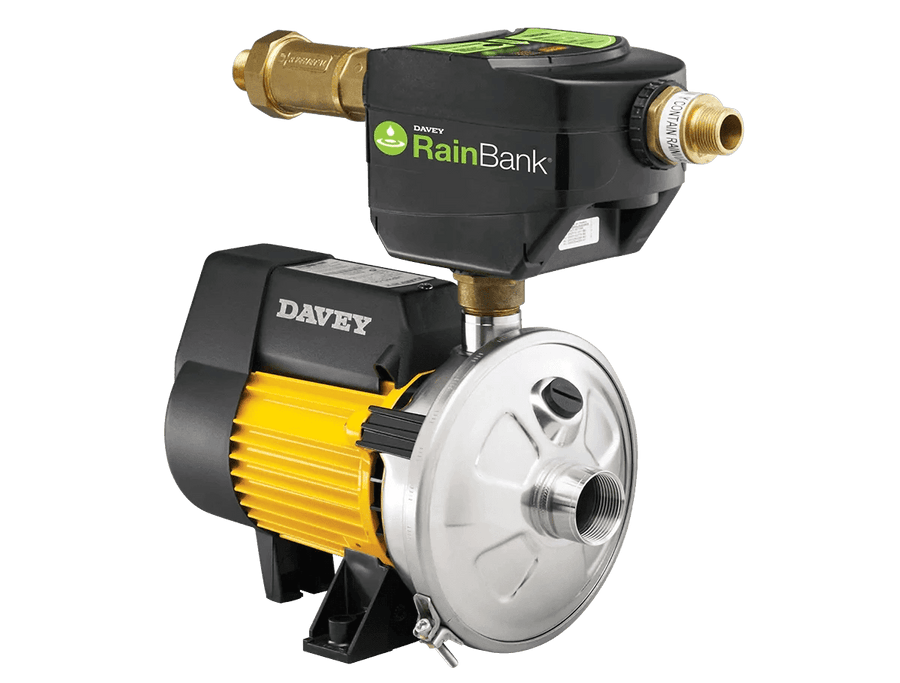
The Davey RainBank KRB2 uses an above-ground pressure pump combined with the RainBank automatic water-source controller.
The pump remains outside the rainwater tank, making it relatively accessible for inspection and servicing.
Davey's current RainBank sizing information places KRB2 in the higher-pressure residential range and includes it for applications such as longer pipe runs and double-storey homes where the complete hydraulic design suits.
Why Choose an Above-Ground RainBank Pump?
Accessible Pump
The pump remains outside the tank, simplifying normal visual inspection and service access.
Existing Pump Areas
Surface-mounted systems can suit homes already designed around an external rainwater pressure pump.
Suction Matters
Tank position, suction lift, suction pipework and air leaks all influence surface-pump performance.
Davey RainBank KRBS2 Submersible System
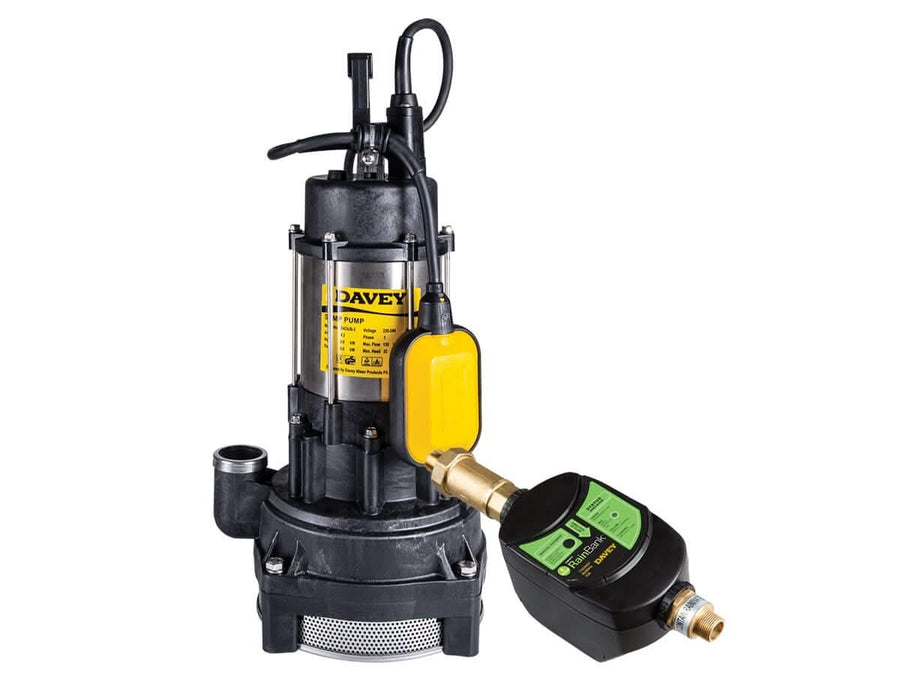
The Davey RainBank KRBS2 uses a submersible pressure pump positioned inside the rainwater tank.
Davey's current specification pairs KRBS2 with its D53A/B submersible pump and publishes approximately 63 L/min at 200kPa.
It can suit installations where an in-tank pump is preferred or where external pump space and pump noise are important considerations.
Why Choose a Submersible RainBank Pump?
Pump Inside Tank
The pressure pump sits within the rainwater tank rather than taking up external ground space.
Lower External Pump Noise
The in-tank position can reduce the amount of pump noise heard around the external tank area.
Tank Access Matters
Future pump servicing or replacement requires suitable access to the tank and pump assembly.
RainBank Systems for Toilet Water Supply
Toilets are one of the most common rainwater harvesting applications.
The system can prioritise tank water for connected toilet cisterns while maintaining mains backup when the rainwater supply becomes unavailable.
Pump sizing should allow for realistic simultaneous demand rather than simply counting the total number of toilets.
RainBank Systems for Laundry Water
Selected laundry fixtures can form part of a properly designed rainwater harvesting installation.
Washing machines can require meaningful flow during filling, so laundry demand should be included when sizing the pump and rainwater pipework.
Automatic mains backup means the laundry can continue receiving water when tank water is unavailable.
Using RainBank for Garden Watering
RainBank can also supply suitable garden taps and irrigation applications from stored rainwater.
Irrigation can create substantially higher flow demand than one toilet or laundry fixture, so the number of sprinklers, required pressure, irrigation zones and pipework need to be considered.
Larger irrigation systems should not be sized from household fixture assumptions alone.
Size Rain Harvesting Pumps by Flow and Pressure
A RainBank controller manages the water source, but the pump still has to provide adequate hydraulic performance.
Pump selection depends on the required flow and pressure at the same operating point.
Consider outlet demand, building height, pipe length, fittings, filters, valves and other pressure losses before choosing the pump.
Building Height Changes Pump Requirements
A low-set house with short pipe runs can require less pump pressure than a two-storey home with long runs to distant toilets or laundry fixtures.
Davey's RainBank selection information places KRB2 and KRBS2 among options used where higher pressure or longer pipe runs are required.
The complete pump curve and actual property layout should still be checked before selection.
RainBank Is Not a Mains Pressure Booster
RainBank provides a mains-water backup source when rainwater is unavailable.
Its primary purpose is not to increase inadequate street mains pressure.
If the home's mains pressure itself is poor, diagnose the mains supply, pipework and restrictions separately.
Rainwater and Mains Water Need Proper Separation
A rainwater harvesting system connects two different water-source arrangements within one property.
The installation needs to maintain appropriate protection between the rainwater system and mains water supply and comply with applicable plumbing and water-provider requirements.
Do not create a manual or improvised connection between rainwater and mains water without the required compliant control arrangement.
The Existing Rainwater Tank Still Matters
A good pump and controller cannot correct every problem with an unsuitable rainwater tank setup.
Check tank condition, tank outlet, sediment, access, overflow, rainwater collection, suction arrangement and available usable water before selecting the pump system.
Submersible systems also require suitable tank access for installation and future servicing.
RainBank Controls the Water Source — It Does Not Treat the Water
A RainBank controller does not filter or disinfect rainwater.
If the intended use requires filtration or treatment, that should be designed separately around the rainwater quality and intended application.
Sediment filters, whole-home filtration or UV treatment may be relevant to some properties, but they perform different functions from the RainBank system.
Rain Harvesting Pumps Need Suitable Electrical Supply
The pump and controller require a suitable electrical connection.
Existing power arrangements should be checked for condition, weather protection and suitability before replacing or installing a rainwater harvesting pump.
Additional electrical work is not automatically included unless it is specifically part of the selected installation package.
RainBank Maintains Mains Backup During Power Loss
Davey specifically designs RainBank so mains water remains available when there is no rainwater or during an electrical interruption.
The rainwater pump itself cannot operate without electrical power, so the system relies on the correctly installed mains-backup pathway in that condition.
Surface and Submersible RainBank Systems Detect Water Availability Differently
Davey RainBank systems are available in several float and floatless configurations across the broader manufacturer range.
The current KRB2 surface system and KRBS2 submersible setup use their specified tank-water detection arrangements to determine when rainwater is available.
Replacement components should match the exact RainBank model rather than being chosen from appearance alone.
Replacing an Existing Davey RainBank System
Existing RainBank installations can be straightforward replacement candidates where the tank, pipework, mains connection and electrical setup remain compliant and serviceable.
Before ordering, confirm:
- Existing RainBank model
- Surface or submersible pump
- Existing pump model
- Tank access
- Tank water connection
- Mains backup connection
- Existing flow and pressure
- Connected fixtures
- Electrical supply
- Controller location
- Valve and fitting condition
- Current plumbing compliance
Do You Need a Complete RainBank System or Just a Pump?
If the RainBank controller remains serviceable but the pressure pump has failed, a complete harvesting system may not always be required.
Likewise, if the pump is serviceable but the automatic changeover controller has failed, the repair pathway can be different.
Diagnose which component has failed before replacing the entire rainwater harvesting setup.
When a Standard Rainwater Pump Is Enough
If the system only needs to supply a garden tap, hose, irrigation system or another independent tank-water outlet, automatic mains backup may not be necessary.
In that case, a standard rainwater pressure pump can be simpler and more economical.
Planning a New RainBank Installation
A new rainwater harvesting installation should be planned as a complete system rather than starting with the pump alone.
- Rainwater tank size
- Tank position
- Surface or submersible pump
- Toilets and laundry connections
- Garden and irrigation demand
- Required flow
- Required pressure
- Mains backup connection
- Backflow and separation requirements
- Pipe sizes
- Electrical supply
- Service access
Rain Harvesting Pumps & Davey RainBank Brisbane
Brisbane is a primary RainBank installation market for Installed Today. Selected rainwater harvesting systems can be ordered with installation in eligible Brisbane, Logan, Ipswich, Moreton Bay and Redlands service areas.
Common applications include rainwater tanks connected to toilets, laundries, garden taps and irrigation where automatic mains-water backup is required.
Final installation requirements depend on tank access, pump type, existing pipework, mains connection, electrical supply, valves, connected fixtures and site conditions.
Rain Harvesting Pumps & Davey RainBank Gold Coast
Selected Davey RainBank systems are also available supplied and installed across eligible Gold Coast service areas.
Choose between a surface-mounted KRB2 and submersible KRBS2 based on tank configuration, required performance, pump location and servicing preferences.
Confirm the complete rainwater and mains-backup plumbing arrangement before ordering.
Buy Rain Harvesting Pumps Across Major Australian Metro Areas
Supply-only RainBank systems are available across supported mainland Australian markets where delivery is available.
Our main supply markets include Brisbane, Gold Coast, Sunshine Coast, Sydney, Melbourne, Perth and Adelaide, together with Townsville, Cairns, Toowoomba, Newcastle, Central Coast, Wollongong and Geelong.
Brisbane and Gold Coast remain the primary Installed Today installation markets. Customers elsewhere can choose supply only and arrange their own suitable licensed installer.
Choose How You Want to Order Your RainBank System
Supply Only
Best if you already have a suitable licensed plumber, pump technician or rainwater-system installer arranged.
Installation, old pump removal, valves, fittings, mains backup plumbing, tank alterations, trenching, electrical work and compliance upgrades are not included unless specifically selected.
Brisbane Installation
Selected RainBank systems are available with installation in eligible Brisbane metro service areas.
Availability depends on tank access, pump type, mains connection, pipework, electrical setup and site conditions.
Gold Coast Installation
Selected RainBank systems are also available supplied and installed in eligible Gold Coast areas.
Final requirements depend on the existing or proposed rainwater harvesting installation.
Choose RainBank When You Need Automatic Mains Backup
The main reason to choose a rainwater harvesting system instead of a standard tank pump is automatic management of rainwater and mains-water supply.
Compare connected fixtures, required flow, required pressure, building height, surface versus submersible pumping, tank access, mains backup, pipework, electrical supply and compliance requirements before ordering.
If automatic mains backup is not required, compare the standard rainwater-pump collection first. If the actual problem is poor mains pressure, use the mains-pressure boosting collection instead.
Rainwater Harvesting Pump FAQs
Common questions about choosing, ordering and installing rainwater harvesting pumps for homes using tank water with automatic mains water backup where suitable.
What is a rainwater harvesting pump?
A rainwater harvesting pump helps move water from a rainwater tank to selected household outlets such as toilets, laundries, garden taps or irrigation. Some systems can automatically switch to mains water backup when tank water is low, depending on the product and installation setup.
What is the difference between above ground and submersible rainwater harvesting pumps?
An above ground rainwater harvesting pump is installed outside the tank in a suitable location, while a submersible pump is installed inside the rainwater tank. The best option depends on tank access, noise preference, available space, pipework, electrical setup, service access and the overall rainwater system design.
Which rainwater harvesting pump should I choose?
Choose the Davey RainBank KRB2 if you want an above ground rainwater harvesting setup where the pump is installed outside the tank. Choose the Davey RainBank KRBS2 if you want a submersible setup where the pump is positioned inside the rainwater tank. Suitability depends on the property, tank, access and plumbing layout.
What is the Davey RainBank KRB2 best suited for?
The Davey RainBank KRB2 is best suited to above ground rainwater harvesting systems where the pump is installed outside the tank. It is commonly used for homes wanting automatic rainwater use with mains water backup for suitable toilets, laundries, garden taps and compliant rainwater reuse systems.
What is the Davey RainBank KRBS2 best suited for?
The Davey RainBank KRBS2 is best suited to suitable rainwater tank setups where a submersible pump is preferred inside the tank. It can be useful where reduced external pump noise is preferred or where the tank, access and pipework suit a submerged pump installation.
Can rainwater harvesting pumps switch to mains water automatically?
Yes, selected rainwater harvesting systems can automatically switch to mains water backup when tank water is low. The setup must be correctly installed and suitable for the property, tank, plumbing layout, water supply and compliance requirements.
What can a rainwater harvesting pump supply?
A rainwater harvesting pump can commonly supply selected outlets such as toilets, laundries, garden taps and irrigation where the system has been designed and installed for those uses. The exact outlets depend on the plumbing layout, tank capacity, pump size, filters, water quality and compliance requirements.
Can I use a rainwater harvesting pump for the whole house?
Some homes use rainwater for broader household supply, but a standard rainwater harvesting setup is often used for selected outlets. Whole home rainwater supply needs to be checked carefully because it depends on tank size, pump capacity, filtration, water quality, pipework, treatment requirements and household demand.
Does a rainwater harvesting pump need filters?
Many rainwater pump setups need suitable filtration or pump protection depending on the tank, water source and how the water is being used. Filters can help protect fixtures, appliances and the pump, but the correct setup depends on sediment levels, tank condition, roof collection area and household requirements.
Can I buy a rainwater harvesting pump supply only?
Yes. Choose supply only if you already have a licensed plumber, pump installer or electrician arranged. Supply-only pricing is for the pump only and does not include installation, valves, fittings, pipework changes, electrical work, rainwater tanks, trenching, old pump removal, disposal or compliance upgrades unless selected separately.
Can I order a rainwater harvesting pump supplied and installed?
Yes. Supplied and installed options are available for selected rainwater harvesting pumps in eligible Brisbane and Gold Coast service areas. Availability depends on your address, tank access, pump type, plumbing layout, electrical setup, mains water connection and site requirements.
Does installation include electrical work?
Electrical work is not automatically included unless shown in the selected installation option or chosen as an add-on. Some pump installations may require a suitable power point, circuit changes, weatherproof electrical work, isolation, protection or other work by a licensed electrician.
Does installation include pipework changes or extra valves?
Pipework changes, valves, non-return valves, pressure limiting valves, bypasses, mains water backup connections, fittings, filters, trenching and other upgrades are not automatically included unless shown in the selected installation option or chosen as an add-on. Site requirements can vary between homes.
Does installation include old pump removal and disposal?
Old pump removal and disposal are not automatically included unless shown in the selected installation option or chosen as an add-on. Access, pump location, tank access, pipework, electrical connections and site conditions can affect what is required.
Do you install rainwater harvesting pumps in Brisbane and the Gold Coast?
Supplied and installed options are available for selected rainwater harvesting pumps in eligible Brisbane and Gold Coast service areas. Availability depends on the selected pump, your address, tank access, existing plumbing, electrical setup and installation requirements.