

Water Filter vs Water Softener: What’s the Difference?
Water Filter vs Water Softener: What’s the Difference?
Filtration and softening solve different water problems. Start with what you are trying to change.
A water filter may target sediment, chlorine, taste, odour or selected contaminants. A water softener is designed around hardness minerals. Scale-control products are another category again. Use the tool to separate the problem before choosing equipment.
What Water Problem Are You Trying to Solve?
Choose the symptom closest to yours. This does not diagnose water quality, but it helps identify which treatment category is worth investigating first.
Choose a water problem above
The result will explain whether filtration, hardness treatment or further water-quality investigation is the more relevant starting point.
Water Filters and Water Softeners Do Different Jobs
The words are often used as if they mean the same thing, but the treatment mechanisms and target problems are different.
A conventional water filter passes water through one or more filtration media. Depending on the system and cartridge, that may reduce sediment, chlorine, taste, odour and selected contaminants. A water softener generally uses an ion-exchange process designed to reduce hardness minerals such as calcium and magnesium.
That difference matters because a filter chosen for chlorine or sediment is not automatically a solution for hardness, and a softener chosen for hardness is not automatically the right system for drinking-water taste, sediment or every contaminant.
What a Water Filter Is For
- Reducing sediment and suspended particles where the selected filter is rated for them.
- Reducing chlorine taste and odour with suitable activated-carbon media.
- Improving drinking-water taste.
- Targeting selected contaminants with specialist media or membrane systems.
- Filtering either one drinking-water outlet or the whole home, depending on the system.
What a Water Softener Is For
- Reducing hardness minerals associated with hard water.
- Addressing scale formation caused by calcium and magnesium.
- Changing the mineral composition of the water rather than simply straining particles.
- Helping reduce hard-water scale on fixtures and appliances where hardness is confirmed.
- Requiring different maintenance and operating considerations from a standard filter.
Filtration, Softening and Scale Control Are Not Interchangeable
The right treatment depends on what is actually in the water and what outcome you want.
Filtration
Uses a filter medium, membrane or treatment stage to reduce particular substances. Performance depends on the exact product, media, micron rating, flow and certified reduction claims.
Ion-Exchange Softening
Designed around hardness. A conventional softener exchanges hardness ions such as calcium and magnesium for other ions, commonly sodium or potassium depending on the system.
Scale Treatment
Some products aim to manage scale without operating like a traditional softener. Their mechanism and expected outcome can differ, so “scale control” should not automatically be treated as “soft water”.
Match the Treatment to the Symptom
A visible symptom can point you in a direction, but it does not replace testing where water quality is uncertain.
Chlorine Taste or Smell
Suitable activated-carbon filtration is the usual category to investigate. The exact system should be selected around water source, flow rate, contact time and product reduction claims.
Sediment, Rust or Dirt
Sediment filtration is the usual starting category. Micron rating and cartridge surface area matter because finer filtration can increase restriction and load faster in dirty water.
White Scale Deposits
Confirm hardness before assuming a filter will solve it. If scale is being caused by hardness minerals, a hardness-treatment or softening solution may be more relevant than standard sediment or carbon filtration.
Better Water at the Kitchen Sink
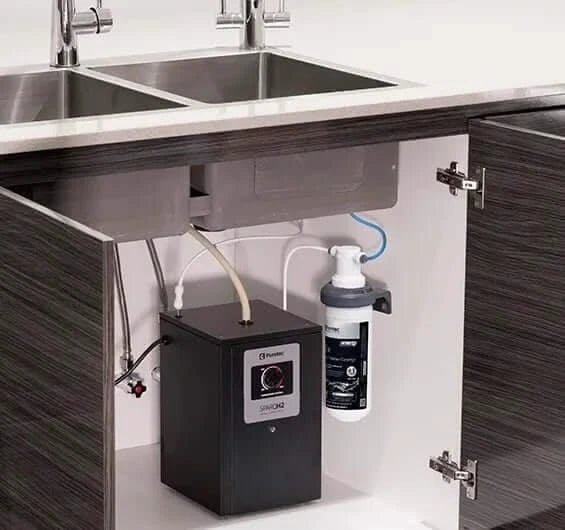
A drinking-water system may be the more targeted option when the goal is taste, odour or selected drinking-water contaminants rather than whole-home hardness treatment.
Broader Dissolved Contaminants
Some dissolved substances are not removed by ordinary sediment or carbon cartridges. A membrane process such as reverse osmosis may be relevant depending on the target contaminant and product specification.
Uncertain Water Quality
When the concern is not clear, start with the water source and an appropriate water-quality assessment rather than buying equipment based only on appearance, taste or internet assumptions.
Hard Water: What Are You Actually Looking For?
Hardness commonly shows itself through scale rather than visible dirt. That is why a clear-looking water supply can still be hard.
A Better Way to Choose Water Treatment
Start with the problem, then the water source, then the treatment technology. Do not start with a product name.
Identify the Problem
Is it sediment, chlorine taste, scale, drinking-water quality or something else?
Check the Water Source
Mains, rainwater, bore and other sources can require very different treatment strategies.
Match the Technology
Compare sediment, carbon, membrane, UV, softening or other treatment only after defining the target.
Confirm the Product
Check the actual product specification, flow, maintenance requirements and contaminant-reduction claims before ordering.
Explore Water Filtration Options
If your goal is filtration rather than hardness treatment, continue into the relevant Installed Today water-filtration category.
Move From the Problem to the Right Filtration Category
These links are limited to Installed Today Water Filtration destinations currently available from the main menu.
Water Filter vs Water Softener FAQs
Is a water filter the same as a water softener?
No. A water filter and a water softener use different treatment approaches and target different problems. Filters may reduce sediment, chlorine, taste, odour or selected contaminants, while a conventional softener is primarily designed to reduce hardness minerals.
Does a whole house water filter soften water?
Not necessarily. A whole-home filter may treat sediment, chlorine or other selected substances but that does not automatically mean it reduces hardness. Check the exact treatment media and product claims.
Will a carbon filter remove hard-water scale?
Standard activated-carbon filtration is generally used for substances such as chlorine, taste and odour rather than as a conventional hardness-removal process. If scale is the problem, first confirm whether hardness is actually causing it.
What is the difference between water softening and scale control?
Traditional softening reduces hardness ions through a process such as ion exchange. Scale-control products may instead aim to change how minerals behave or deposit. They should not automatically be treated as equivalent to softened water.
Do I need a filter and a water softener?
Possibly, but only if the water has separate problems that require separate treatment. For example, a property could have both chlorine taste and confirmed hardness. The correct combination depends on the water source, test results and desired outcome.
How do I know if my water is hard?
Scale, spotting and poor soap performance can be clues, but testing is the better way to confirm hardness. Appearance alone cannot reliably identify the mineral concentration.
Can reverse osmosis replace a water softener?
Reverse osmosis and whole-home softening are normally used for different applications. RO is commonly used for a dedicated drinking-water supply, while a softener is generally intended to treat hardness across a larger water supply. Suitability depends on the actual objective and system design.
Define the Water Problem Before Choosing the Equipment
Use filtration for a filtration problem, investigate hardness treatment for a hardness problem, and confirm uncertain water quality before buying a system based on symptoms alone.
